Exciting Events and Activities in St. Louis
South City Duplex Investment Guide for Small Multifamily
Exciting Events and Activities in St. Louis
If you have been eyeing a South City duplex or small multifamily property, you already know the appeal. A well-located brick flat can offer rental income, long-term upside, and a foothold in some of St. Louis’s most character-rich neighborhoods. The challenge is that South City is not one simple market, and the right buy often comes down to block-by-block judgment, realistic underwriting, and a sharp eye for building condition. This guide will help you understand where the opportunities are, what numbers matter most, and how to approach these properties with more confidence. Let’s dive in.
South City works best as a collection of distinct neighborhoods, not one uniform submarket. Areas like Tower Grove South, Shaw, Tower Grove East, Benton Park, Fox Park, Forest Park Southeast, Dutchtown, Gravois Park, St. Louis Hills, and Lindenwood Park each have different boundaries, housing stock, and amenity patterns, as shown on the City of St. Louis neighborhood pages.
That variation is exactly why investors pay attention here. According to Northmarq’s 1Q 2025 St. Louis market report, St. Louis City South posted asking rent of $1,397 per month, up 6.9% year over year, while broader St. Louis multifamily vacancy measured 6.2%. At the same time, the same report notes that roughly 13% of the city’s vacant parcels are in South City, which reinforces an important point: selection matters.
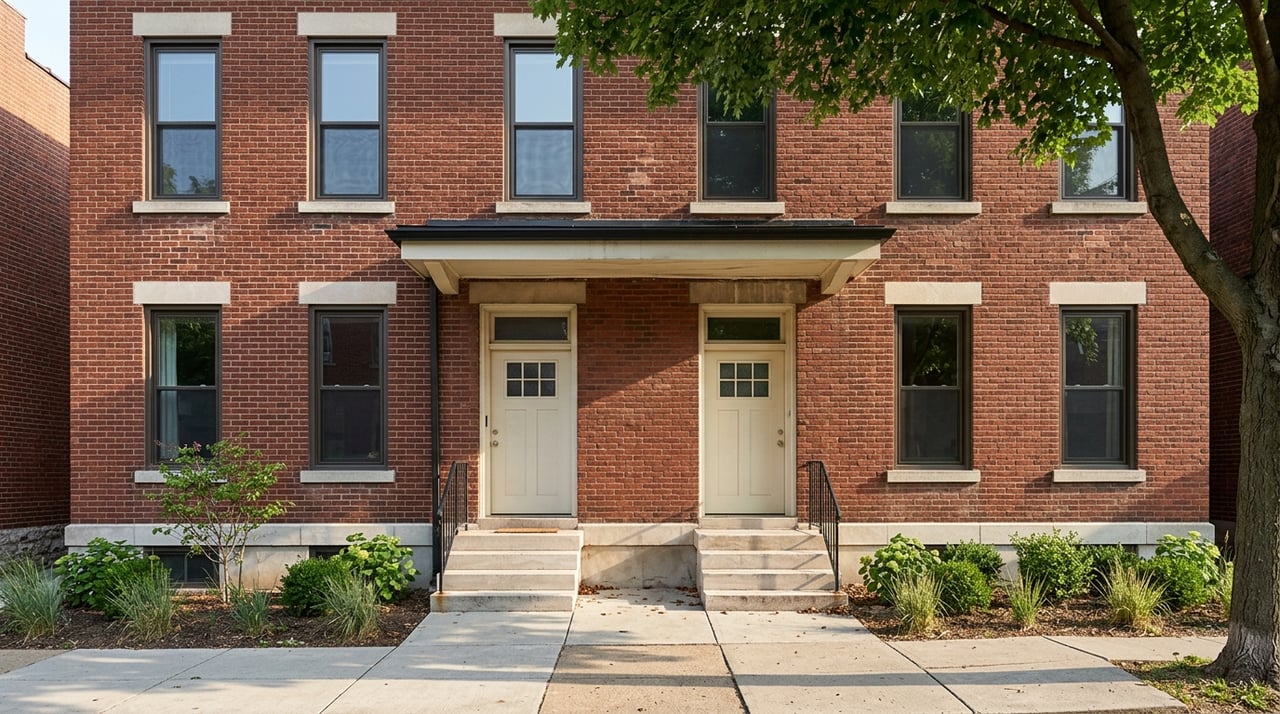
In South City, the typical duplex or small multifamily building is usually a pre-war brick flat rather than a newer apartment product. Official neighborhood overviews describe Tower Grove East as a place shaped by homes and flats built from the mid-1890s through the 1920s, while Dutchtown north of Meramec is known for many two- and four-family flats from about 1890 to 1910. Benton Park, Shaw, Fox Park, and Forest Park Southeast each bring their own historic mix as well, as outlined by the City’s neighborhood histories.
For you as a buyer, that means unit count is only part of the story. A two-family flat, a four-family, or a small apartment building may all look similar on paper, but the real value often depends on layout, deferred maintenance, and how the building sits on its block. A handsome brick exterior can be a great starting point, but it does not remove the need to study systems, permits, and rent potential carefully.
One of the biggest mistakes buyers make is treating South City as if every street in the same neighborhood performs the same way. The City’s Market Value Analysis framework uses factors like sale prices, vacancy, permit activity, foreclosures, non-residential share, and subsidized rental stock to classify market types. That is a useful reminder that strong long-term holds usually show multiple positive signals at once.
In practical terms, that means you want to look beyond the listing photos. Study the surrounding block, nearby vacancy, reinvestment activity, and whether adjacent properties appear cared for or deferred. In South City, a solid building on a stable or improving block usually tells a much better investment story than a cheaper property with a long list of unknowns.
As a citywide reference point, Apartments.com rent trend data shows St. Louis averages at about $1,139 for a one-bedroom, $1,368 for a two-bedroom, and $1,658 for a three-bedroom apartment. For small multifamily buyers, neighborhood-level asking rents provide a more useful starting bracket.
Here is a snapshot of asking-rent averages mentioned in the research:
| Neighborhood | 1-Bed Average | 2-Bed Average |
|---|---|---|
| Tower Grove South | $817 | $972 |
| Shaw | $926 | $1,284 |
| Benton Park | $899 | $1,185 |
| Tower Grove East | $710 | $936 |
| Forest Park Southeast | $1,612 | $2,187 |
| Gravois Park | $865 | $1,328 |
| Dutchtown South | $598 | $892 |
| St. Louis Hills | $633 | $846 |
| Bevo Mill | $535 | $545 |
| Lindenwood Park | $933 | $1,363 |
| Northampton | $844 | $1,196 |
These are asking-rent averages, not actual rent rolls, so they should be used as an underwriting guide rather than a promise. They are still helpful because they show how widely rents can vary within South City. A property in Forest Park Southeast lives in a very different rent environment than one in Bevo Mill or Dutchtown South.
Recent movement also shows why simple neighborhood labels are not enough. According to local guide data from Apartments.com, Tower Grove South asking rents rose 2.4% year over year, Benton Park rose 4.1%, and Forest Park Southeast rose 0.3%, while Shaw dipped 0.2% and Tower Grove East dipped 1.3%.
That kind of mixed performance tells you that finishes, condition, and exact location matter just as much as the neighborhood name. If you are underwriting a duplex or four-family, it pays to be conservative. Assume that quality and management execution will drive whether your rents sit at the high end or low end of the local range.
Vacancy data can help you read market tightness and risk. Using 2020 census housing-unit counts published by the City of St. Louis neighborhood data portal, Tower Grove South and Shaw each showed about 10.5% vacant housing units, Benton Park about 16.1%, Forest Park Southeast about 19.2%, and Benton Park West about 22.4%.
These are housing-unit vacancy rates, not parcel-vacancy measures, so they should be read with care. Still, they help frame one of the central truths of South City investing: some areas feel tighter and more stable, while others require a larger cushion for turnover, downtime, and capital improvements.
Permit activity offers another useful clue. The City’s building permit dashboard shows substantial 2020 to 2025 permit volume in Tower Grove South, Shaw, Forest Park Southeast, Benton Park, St. Louis Hills, and Bevo Mill. Permit activity does not guarantee appreciation, but it can signal where reinvestment is continuing to flow.
If you are considering a house-hack or owner-occupied duplex, Tower Grove South and Shaw stand out as strong fits. Tower Grove South is bounded by Arsenal, South Grand, Chippewa, and South Kingshighway, and the City’s neighborhood page highlights its active business and residential character. Shaw also benefits from proximity to major amenities, including the Missouri Botanical Garden and Tower Grove Park.
These neighborhoods tend to appeal to buyers who want a blend of historic building stock and everyday livability. For a duplex or small multifamily purchase, that can support renter demand in a way that is based on convenience and neighborhood fabric, not just price point.
If your goal is a higher-rent, amenity-rich asset, Forest Park Southeast, Benton Park, and Fox Park deserve a close look. Forest Park Southeast local rent and amenity data points to some of the highest rent levels in this group, while Benton Park offers a long-established historic fabric. Fox Park’s official history notes that about two-thirds of the historic district’s contributing buildings are two- to six-family properties.
These areas may come with a higher basis, but they can make sense for buyers who want stronger end-rent potential and are comfortable paying more upfront for location and amenity access.
For a lower entry basis or a value-add plan, Dutchtown, Gravois Park, Bevo Mill, and Tower Grove East often enter the conversation. Dutchtown’s housing stock includes many two- and four-family buildings, and Tower Grove East remains one of South City’s classic flats neighborhoods. Bevo Mill and parts of the southeast side can offer lower asking-rent benchmarks, which may create room for careful investors who underwrite repairs and vacancy realistically.
These are the kinds of areas where discipline matters most. A value-add property can become a strong long-term hold, but only if your purchase price, renovation budget, and expected rents leave enough room for surprises.
If you plan to live in one unit, financing may be more accessible than many buyers expect. HUD guidance notes that FHA-insured mortgages include two- to four-unit properties and require a 3.5% minimum investment. Freddie Mac’s loan-to-value guidance, cited in the research, also allows eligible conventional owner-occupants to finance two- to four-unit primary residences with as little as 5% down in some cases.
That can make a duplex or small multifamily property especially appealing for buyers who want to offset housing costs with rental income. The key is making sure the financing structure matches your occupancy plan from day one.
With South City’s historic housing stock, you should plan for more than cosmetic updates. The City of St. Louis residential occupancy rules require a Certificate of Inspection before a rental unit can be occupied, although owner-occupied properties are exempt from the residential occupancy permit requirement.
That matters because many South City duplexes are purchased as rentals or house-hacks. Before you buy, factor in inspection readiness, compliance work, and turnover standards. A property that looks rentable during a quick showing may still need meaningful work before it can legally and safely produce income.
Lead risk is another major part of the equation. The EPA’s Renovation, Repair and Painting program states that renovation work in pre-1978 properties can create dangerous lead dust and may require lead-safe certified contractors for covered work. In other words, older properties should be underwritten based on total project cost, not just contract price.
Before you make an offer, it helps to review each property through a practical lens:
A good South City deal is rarely the one with the flashiest headline. More often, it is the property where building condition, block quality, rental demand, and financing all line up in a way that supports steady ownership over time.
If you are thinking about a South City duplex or small multifamily purchase, working with a team that understands both the numbers and the character of these older properties can make a real difference. At Svoboda/Shell Group, we take a thoughtful, design-aware, hyperlocal approach to helping you evaluate opportunities with clarity and confidence.